Define what the window needs to do
A bedroom, a street-facing living room, and a mountain-view great room have different priorities. Decide whether the main concern is privacy, glare, room darkening, or convenient daily adjustment. Fabric samples and the actual room conditions should guide the choice.
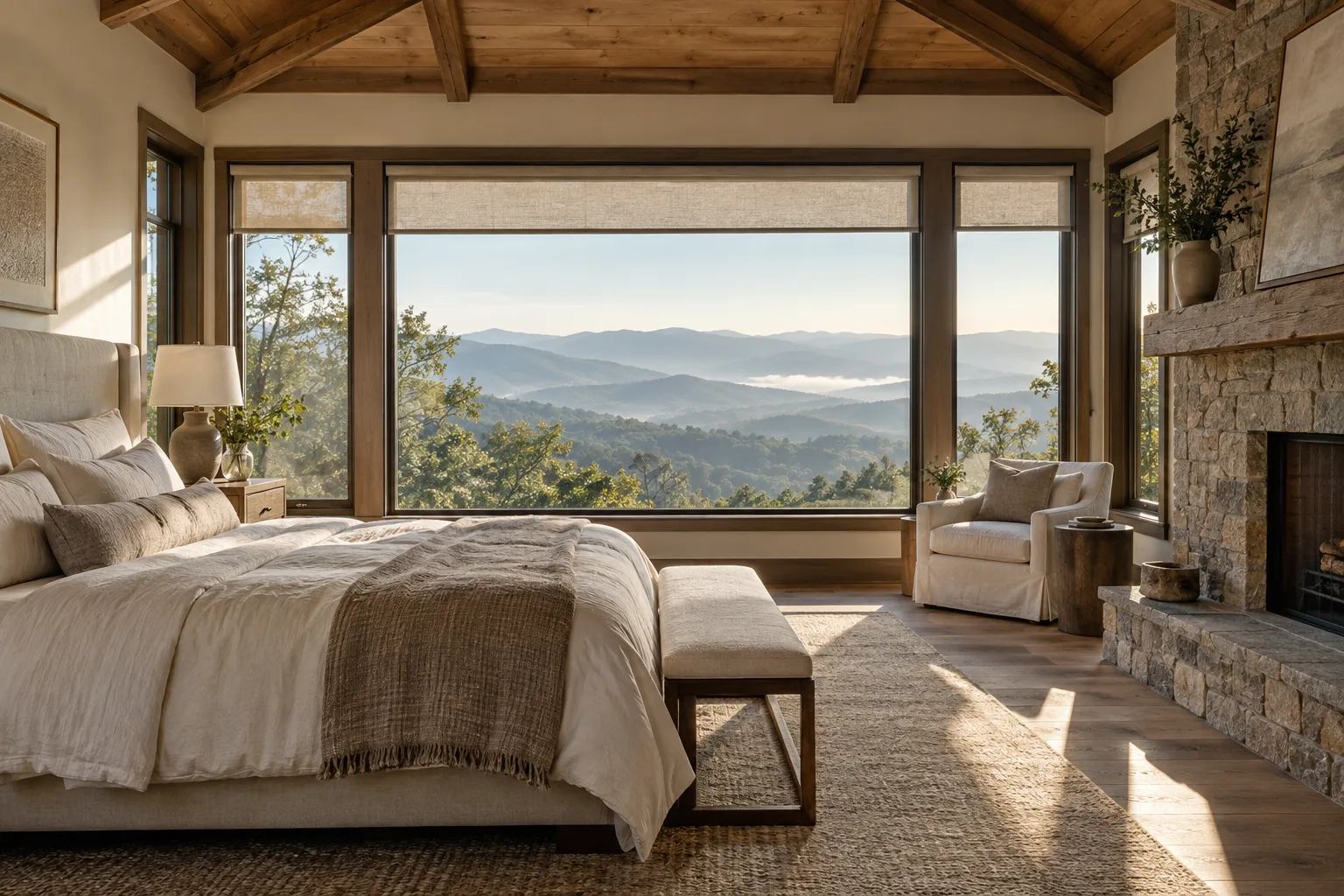
For an Ellijay or Blue Ridge retreat, preserving a view can matter as much as filtering daylight. Discuss each opening individually rather than selecting one treatment for every room by default.
Plan power before choosing a product
Power arrangements vary by shade system. New construction may provide an opportunity to coordinate wiring and concealed power before finishes close. An existing home may call for another supported arrangement based on access and the selected equipment.
The proposal should explain how the shades are powered and serviced, including any routine charging or battery maintenance. Ask how a tall or inaccessible opening affects that maintenance.
Coordinate the installation with the architecture
Window depth, trim, surrounding materials, and space for the treatment affect the mounting approach. Multiple adjacent shades also deserve attention to alignment and the appearance of the finished installation.
Measurements and product requirements must be confirmed before ordering. If a renovation changes trim or window dimensions, coordinate those decisions before finalizing the shade specification.
Connect schedules and everyday controls
Discuss whether shades should operate independently, as room groups, or within supported lighting and comfort scenes. Include physical controls and a straightforward way to override a schedule when the room is being used differently.
Automation compatibility is reviewed for the selected system; a motorized shade is not automatically compatible with every control platform. Share your desired routines, current platform if any, and the windows you want included.
What homeowners ask us.
Will a room-darkening shade eliminate every light gap?
Room-darkening fabric reduces transmitted light, but side gaps and light around the top or bottom depend on the mounting design and window conditions. If near-blackout performance matters, we discuss side channels, fascia, layered treatments, and the visual tradeoffs before ordering.
Can motorized shades be added to an existing home?
Yes, in many cases. We evaluate mounting space, window dimensions, nearby power, accessible wiring routes, and battery options. The goal is a clean installation that respects the existing trim and finishes.
Can several shades move together?
Yes. Shades can often be grouped by room, elevation, or scene while still allowing individual adjustment. We plan groups around daylight, privacy, and how you use the space rather than simply making every shade move at once.